-
PKD1L1 KO Mouse Model
-
Organoid Culture
-
Immunoflourescent Imaging
- Quantitative Digital Histopathology
School of Medicine
The Karpen Lab
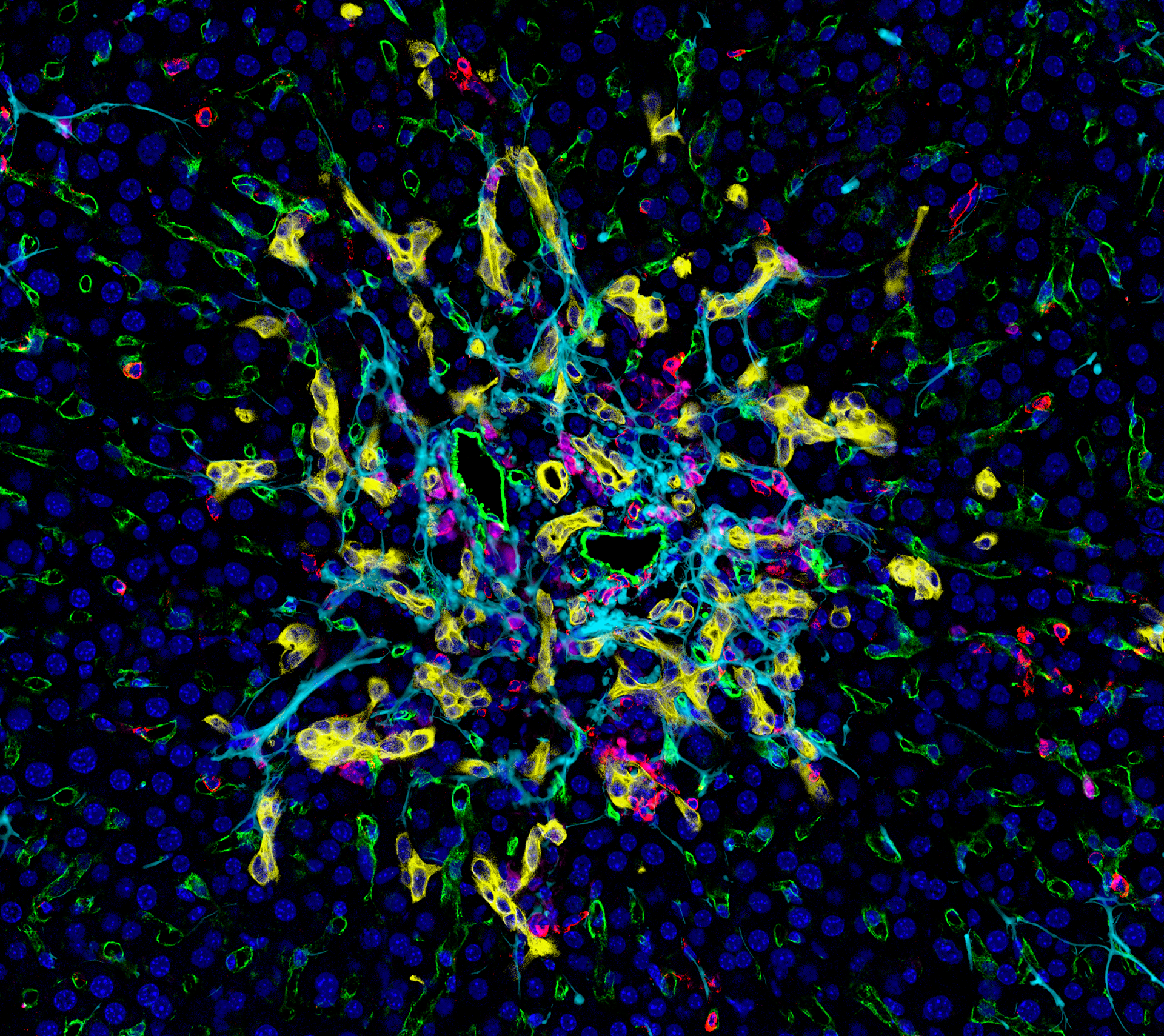
The Karpen Lab develops and studies patients and models of cholestatic liver disease with an emphasis on the genetics of biliary atresia. Building on the Pkd1l1 knockout mouse model of biliary atresia originally created by the Karpen Lab, these models are used to advance knowledge and rational treatments for biliary atresia patients. The group has arcs in in genetic analyses, cell culture, organoid and mouse studies exploring etiopathogenesis of cholestatic and bile acid-mediated diseases.

About Dr. Karpen
Saul J. Karpen, M.D., Ph.D. leads his laboratory with a mission centered on the unique and pressing needs of infants and children with liver disease. As the Chief Scientific Officer of the Stravitz-Sanyal Institute for Liver Disease and Metabolic Health at VCU, Dr. Karpen fosters and integrative environment where basic science meets clinical application.
He leads a multidisciplinary effort to discover novel genetic causes of liver disease and develop targeted therapeutic agents. His work is defined by a commitment to improving clinical care for pediatric patients and bridging the gap between pediatric liver disease and adult care.

PKD1L1 Discovery and Exploration Models
These studies aim to discover how genes that cause biliary atresia lead to the developmental cholangiopathy and massive fibroinflammatory reaction allowing for an evaluation of response to novel therapeutics. (R01 DK135815)

Genetic contributions to Biliary Atresia
Working with the NIDDK-supported Childhood Liver Disease Research Network (ChiLDReN) we are identifying gene variants associated with biliary atresia patients. These candidate genes are functionally evaluated in organoid and mouse models. (U01 DK62470)

Bile Acid Biology Therapeutic Targets
Our lab translates molecular insights into targeted therapeutics that restore bile acid balance and prevent multi-organ injury. We are dedicated to protecting organ function in pediatric cholestatic diseases through the modulation of systemic bile acid recirculation.

Clinical Research on Biliary Atresia and Cholestasis
Clinical Research on treatments for biliary atresia and genetic forms of cholestasis. The global lead for the BOLD study (NCT04336722) and participant in other trials on liver disease in children. Additional clinical trials for adult and pediatric diseases can be found in the Grants and Clinical Trials section.
More about the Karpen Lab
Unique Techniques, Models, or Technologies Used
Collaborations/Partnerships
Paul Dawson, Ph.D., Emory University
Publications
-
Trauner M, Karpen SJ, Dawson PA.
Benefits and challenges to therapeutic targeting of bile acid circulation in cholestatic liver disease.
Hepatology. 2025 Oct 1;82(4):855-876. doi: 10.1097/HEP.0000000000001438. Epub 2025 Jul 2. PMID: 40601300; PMCID: PMC12440292. -
Beuers U, Banales JM, Karpen SJ, Keitel V, Williamson C, Trauner M.
The history and future of bile acid therapies.
J Hepatol. 2025 Nov;83(5):1172-1188. doi: 10.1016/j.jhep.2025.06.010. Epub 2025 Jun 20. PMID: 40545045; PMCID: PMC13094352. -
Hellen DJ, Karpen SJ.
Genetic Contributions to Biliary Atresia: A Developmental Cholangiopathy.
Semin Liver Dis. 2023 Aug;43(3):323-335. doi: 10.1055/a-2153-8927. Epub 2023 Aug 15. Erratum in: Semin Liver Dis. 2023 Aug;43(3):e2. doi: 10.1055/s-0043-1776036. PMID: 37582400; PMCID: PMC13060548. -
Hellen DJ, Bennett A, Malla S, Klindt C, Rao A, Dawson PA, Karpen SJ.
Liver-restricted deletion of the biliary atresia candidate gene Pkd1l1 causes bile duct dysmorphogenesis and ciliopathy.
Hepatology. 2023 Apr 1;77(4):1274-1286. doi: 10.1097/HEP.0000000000000029. Epub 2023 Jan 3. PMID: 36645229; PMCID: PMC12440248. -
Berauer JP, … [and 32 others including, Karpen SJ]
Identification of Polycystic Kidney Disease 1 Like 1 Gene Variants in Children With Biliary Atresia Splenic Malformation Syndrome.
Hepatology. 2019 Sep;70(3):899-910. doi: 10.1002/hep.30515. Epub 2019 Mar 21. PMID: 30664273; PMCID: PMC6642859.
Find more publications by Dr. Karpen on PubMed.
Grants and Clinical Trials
Grants
- Modeling Genetic Contributions to Biliary Atresia
- Sponsor: NIDDK
- Project Number: 5R01DK135815-03
- VCU-Atlanta Center for the Childhood Liver Disease Research Network (ChiLDReN)
- Sponsor: NIDDK
- Project Number: 5U01DK062470-22
Clinical Trials
Clinical Trials by the ChiLDReN Network:
- Efficacy and Safety of Odevixibat in Children with Biliary Atresia Who Have Undergone a Kasai HPE (BOLD)
- Sponsor: Albireo, an Ipsen Company
- Clinicaltrials.gov ID: NCT04336722
- An Open-label Extension Study to Evaluate Long-Term Efficacy and Safety of Odevixibat in Children with Biliary Atresia (BOLD-EXT)
- Sponsor: Albireo, an Ipsen Company
- Clinicaltrials.gov ID: NCT05426733
- A Prospective Database of Infants With Cholestasis (PROBE)
- Sponsor: Arbor Research Collaborative for Health
- Clinicaltrials.gov ID: NCT00061828
- Biliary Atresia Study in Infants and Children (BASIC)
- Sponsor: Arbor Research Collaborative for Health
- Clinicaltrials.gov ID: NCT00345553
- Primary Sclerosing Cholangitis in Children
- Sponsor: Arbor Research Collaborative for Health
- Clinicaltrials.gov ID: NCT04181138
Additional Clinical Trials by the ChiLDReN Network can be found on the ChiLDReN Network website.
Team Members
- Thomas Andl, Ph.D. – Director of Molecular Studies
- Stephen Hoang, Ph.D. – Director of Biomedical Data Science
- Andrew Pryor – Senior Research Lab Manager; Director of Cell Isolation Core
- Jinjing Chen, Ph.D. – Senior Research Scientist
- Matthew Dalton – Research Lab Technician
- Dong Fu, Ph.D. – Senior Research Scientist
- Ronnie Li, Ph.D. – Bioinformatics Research Scientist
Current Students
- Doreen Akorwome – Graduate Student
- Dhanush Bearelly – Undergraduate Student
- Durga Dham – Undergraduate Student
- Diya Menon – Undergraduate Student