Stravitz-Sanyal Institute moving full speed ahead
 “How do we grasp the future?”
That challenge, posed to participants of the Stravitz-Sanyal Institute for Liver Disease and Metabolic Health’s second annual research retreat, set the tone for a day of energy, ideas, and forward momentum.
Led by Chief Scientific Officer Saul Karpen, M.D., Ph.D., dozens of faculty members and staff came together on July 31 to share updates on current research and to help shape what’s next for the institute.
Institute Director Arun Sanyal, M.D., kicked off the all-day retreat by motivating the group with a clear goal: “My hope is that you leave at the end of the day excited about the year ahead.”
As NIH funding continues to face pressure, Sanyal directed attention to a detailed status update presented by Senior Scientific Programs Manager Julyann Pérez Mayoral. For the first half of 2026CY, the institute reported 33 active grants led by 11 principal investigators, totaling $15.6 million. During the same period, there were 38 clinical trials across 9 principal investigators, totaling $16.5 million in revenue. The research portfolio remained strongly focused on metabolic disease, with 16 studies underway, followed by autoimmune and cholestatic research, with six studies each.
That depth of work translated into productivity as well: faculty contributed to 135 publications in the first half of the year, appearing in journals with an average impact factor of 14.7. Sanyal, along with Jasmohan Bajaj, M.D., and Juan Pablo Arab, M.D., led the institute’s authorship during this period.
 Cynthia Mathews, the institute’s director of nursing, joined Sanyal to outline the holistic, multidisciplinary care pathway they’ve developed for VCU liver patients. (The approach has garnered international interest, with clinicians in Russia and Pakistan incorporating it, with 73,000 copies printed in Russian.) They introduced the new SSI “risk visualizer,” designed to view each patient through a broader lens — liver health alongside kidney risk, diabetes, cardiovascular risks, and blood pressure — so care targets the whole person, not just a single diagnosis.
Mathews shared clinical priorities for the academic year, including:
- Consolidating and growing the current program
- Establishing a decompensated cirrhosis and liver survivor program
- Building out a rare disease program
Junior faculty also helped move the conversation forward. S. Obi Aseem, M.D., Ph.D., and Raseen Tariq, M.D., presented research updates on cholestatic liver diseases and inflammatory bowel disease, respectively. Clinical research updates were provided by Ashley Lawrence (clinical research structure), Amon Asgharpour, M.D. (sponsored clinical trials), Jasmohan Bajaj, M.D. (collaboration with the VA), and Danielle Kirkman, Ph.D. (LiverFit, a 12-week supervised, tailored program for patients).
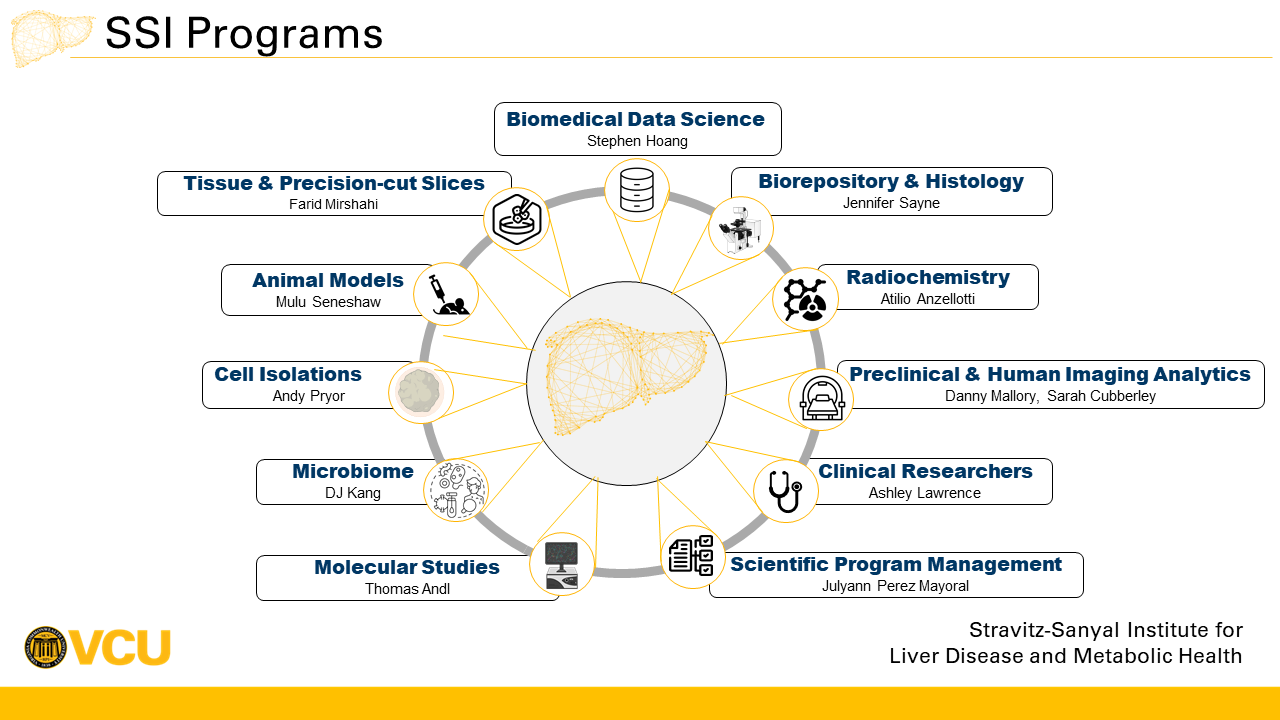 In the afternoon, directors of the institute’s programs and “cores,” covering radiochemistry, biorepository/histology, molecular imaging, cell isolations, and data science, outlined progress and ongoing efforts across the institute’s infrastructure.
Breakout sessions then focused on three key areas: clinical research, data science, and grant innovation.
Closing the retreat, Sanyal offered a rallying message: “The future belongs to those who think about today what others haven’t yet imagined. Execute with conviction, and others will follow.”
Held on VCU’s academic campus, this year’s retreat was organized by Julyann Pérez Mayoral and Chantay Harris, with support from other institute staff.